 Milicz.app
Former Border at Przywsie (1920–1939)
Przywsie
Traces of the 1920–1939 Polish-German border: barrier abutments, a former border post and stone boundary markers.
About
Przywsie, called Grenzvorwerk (“border farm”) until 1945, lies just about 0.5 km from the historic boundary between Silesia and Greater Poland. Between 1920 and 1939 this was the state border between Poland and Germany: the village was a German border settlement, and the Polish county of Rawicz began on the other side. A road border crossing was set up here in spring 1920, and the village had a customs office.
Two massive steel abutments of the German border barrier still survive, along with the former border-control building, clearly visible from national road no. 5. An old stone boundary post stands at the edge of neighbouring Dębno Polskie; according to Żmigród municipality, a stone bearing an inscription referring to the 1919 Treaty of Versailles was also unveiled here in 2019. The old border line now marks the boundary between the Lower Silesian and Greater Poland voivodeships.
It's an unusual open-air history lesson that needs only a short stop. The remains stand by public roads and can be seen free of charge at any time; some are next to private properties, so please view them from the road.
Nearby
-
 Heritage siteAudio
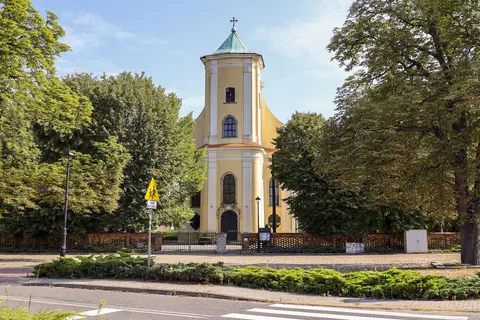
Church of St Charles Borromeo, Radziądz
A late-Baroque gem of 1727–1735 with an oval interior, founded by the Hatzfeldt family, on the Żmigród–Milicz road.
-
 Nature
Radziądz Ponds
Extensive ponds with an observation point.
-
Hotel
Hostel Stanica Rowerowa
A cyclists' hostel in Żmigród's palace park: 52 beds, en-suite rooms, bike storage, from 150 zł per night.
-
 Heritage siteAudio
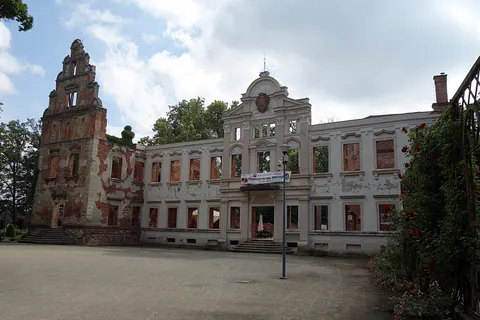
Hatzfeldt Castle and Palace Ruins in Żmigród
A tower from 1560 and the ruined palace where, in 1813, the plan to defeat Napoleon was drawn up.